
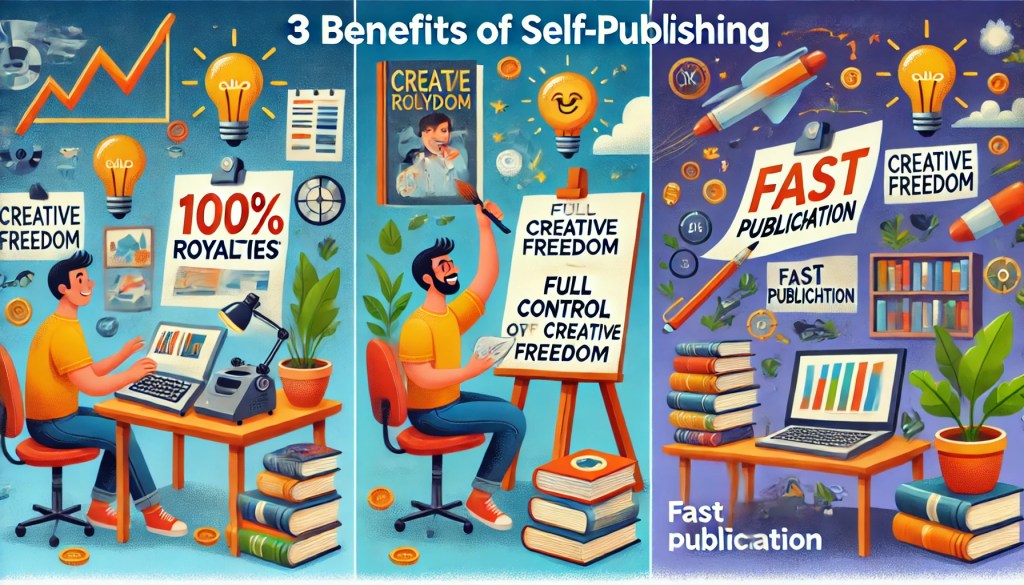
I have published four books. 3 of them have been self-published and the most recent one I have used a Spanish editorial company (I´m going to write about that experience in a future blog). Self-publishing has become an increasingly popular route for authors, offering numerous advantages over traditional publishing. In this article, we will explore three key benefits of self-publishing, which can significantly impact an author’s journey and success. These benefits include faster publication, extensive learning opportunities, and higher royalties. PS: I am working on another book which I’m going to self-publish soon.
1. Faster Publication.
Efficiency and Control
One of the most significant benefits of self-publishing is the speed at which an author can bring their work to market. Traditional publishing often involves a lengthy process that includes submitting manuscripts, waiting for acceptance, undergoing multiple rounds of editing, and aligning with the publisher’s schedule. This process can take months or even years. In contrast, self-publishing allows authors to bypass these steps and retain complete control over their timeline.
Direct Management
When self-publishing, authors act as their own project managers. They oversee every aspect of the publication process, from writing and editing to designing the cover and formatting the book. This direct management means that authors can set their own deadlines and work at their own pace. If an author is dedicated and organized, they can publish their book in a matter of weeks or months, depending on the complexity of the project.
Quick Decision-Making
Another advantage is the ability to make quick decisions. There is no need to wait for approval from a publisher or editorial board. Authors can decide when their book is ready for publication and proceed without delay. This autonomy not only accelerates the process but also allows for immediate implementation of any necessary changes or updates.
2. Extensive Learning Opportunities.
Comprehensive Skill Development
Self-publishing is a journey of continuous learning and skill development. Authors who choose this path are often surprised by the range of skills they acquire. From understanding the intricacies of platforms like Kindle Direct Publishing (KDP) to mastering the art of book marketing, self-published authors gain valuable knowledge that extends beyond writing.
Editing and Formatting
One of the first areas where authors gain experience is in editing and formatting their manuscripts. While many choose to hire professional editors, the self-publishing process encourages authors to understand the basics of editing to ensure their vision is accurately conveyed. Additionally, learning how to format a book for various publishing platforms is an essential skill that can save time and money.
Marketing and Promotion
Marketing is another critical area where self-published authors gain expertise. Without the support of a traditional publisher’s marketing team, authors must learn to promote their books effectively. This includes understanding social media marketing, creating book trailers, organizing virtual book tours, and leveraging online advertising. These skills are invaluable and can be applied to future projects or even other areas of professional life.
Project Management
Self-publishing requires strong project management skills. Authors must coordinate various tasks, manage timelines, and often collaborate with freelancers for services such as cover design and editing. This experience can enhance an author’s organizational abilities and improve their efficiency in managing complex projects.
3. Higher Royalties.
Financial Rewards
One of the most compelling reasons to choose self-publishing is the potential for higher royalties. Traditional publishers typically offer royalties ranging from 10% to 15% of the book’s net profit. In contrast, self-publishing platforms like Amazon’s KDP offer royalties of up to 70% on eBooks priced within a certain range.
Investment and Returns
While self-publishing requires an initial investment for services such as editing, cover design, and marketing, the potential returns are significantly higher. Authors who successfully market their books can see substantial profits, making the upfront investment worthwhile. The ability to set their own prices and run promotions also gives authors greater flexibility in maximizing their earnings.
Retaining Rights and Profits
Another financial benefit of self-publishing is that authors retain all rights to their work. This means they can continue to earn from their books for as long as they remain on the market. Additionally, they have the freedom to create derivative works, such as audiobooks or special editions, and retain all associated profits.
Self-publishing offers a wealth of benefits that can empower authors and enhance their careers. The speed of publication, the opportunity to learn new skills, and the potential for higher royalties make it an attractive option for many writers. As the publishing landscape continues to evolve, self-publishing stands out as a viable and rewarding path for authors looking to take control of their work and achieve success on their own terms.
There are more benefits to self-publishing that I will be talking further on, these are only three of the most important. Don’t forget to comment and subscribe if you want to receive notifications every time I publish a post. Thanks for reading.
 J. A. Méndez Authors Page and Blog