
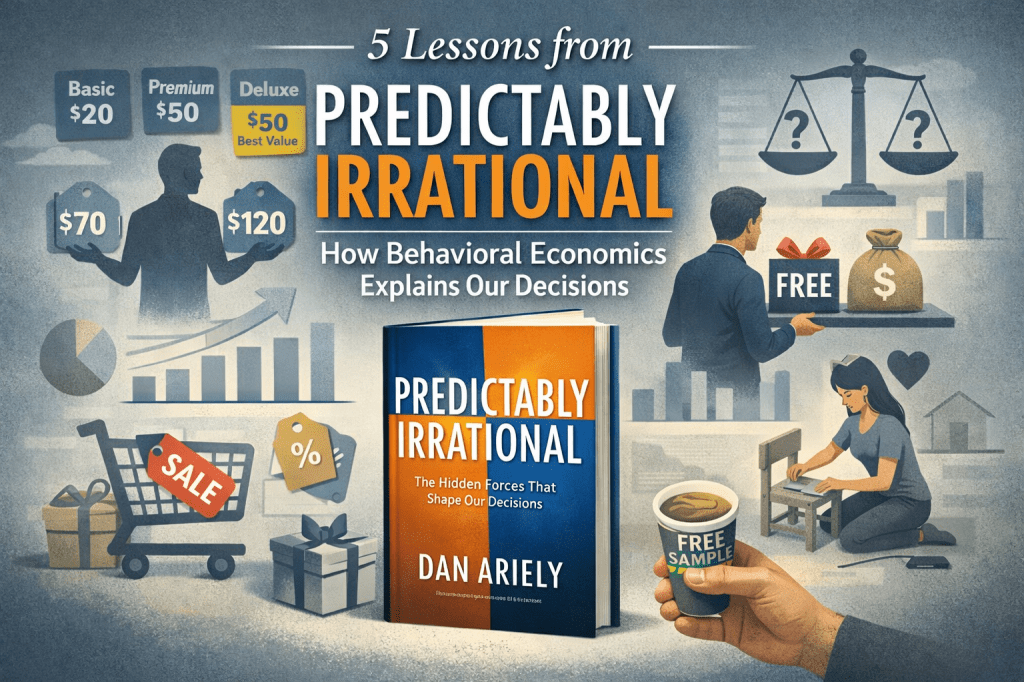
What Behavioral Economics Teaches Us About Decision-Making, Marketing, and Human Bias
Predictably Irrational by Dan Ariely is one of the most influential books in the field of behavioral economics. Rather than assuming that humans act logically when making financial decisions, Ariely demonstrates—through clever experiments—that our behavior is systematically irrational.
Using studies conducted largely with college students, Ariely reveals how our decisions are shaped by context, emotion, and subtle manipulation. Even more unsettling, corporations and advertisers understand these irrational patterns and deliberately design pricing, promotions, and messaging to exploit them.
Below are five of the most important lessons from Predictably Irrational—insights that can help you become a more conscious consumer and a better decision-maker.
1. Humans Rarely Choose in Absolute Terms
One of the book’s central ideas is that we do not evaluate value objectively. Instead, we rely on comparisons and reference points to decide whether something is worth buying.
We judge a product’s value based on:
- How it is presented
- What alternatives are shown next to it
- What marketers tell us it is worth
This explains why companies often offer three pricing options, knowing most people will choose the middle one—even if it is not the best value. Our decisions are guided less by intrinsic worth and more by relative positioning.
Key takeaway: Choice architecture heavily influences what we buy.
2. The Fallacy of Supply and Demand
Traditional economics assumes that markets function efficiently when buyers and sellers behave rationally. Ariely challenges this assumption.
He argues that:
A free market based on supply and demand works only if people are rational—which they are not.
Because consumers are predictably irrational, markets can be manipulated through anchoring, framing, and emotional triggers. This undermines the idea of a perfectly “free” market and supports the need for regulation to protect consumers from exploitation.
Key takeaway: Markets are shaped by psychology, not just economics.
3. Nothing Is Ever Truly Free
Few words are more powerful in marketing than “free.” Ariely shows that people react disproportionately to free offers—even when they are economically inferior.
In several experiments, participants overwhelmingly chose:
- A free but lower-quality product
- Over a better product that costs only slightly more
Free samples, trial offers, and bonuses work because they short-circuit rational analysis. Supermarkets know this well when they offer free tastings that dramatically increase purchase rates.
Key takeaway: “Free” is one of the strongest psychological hooks in consumer behavior.
4. Why We Should Not Monetize Favors
Ariely draws a crucial distinction between social norms and market norms.
- Social norms involve trust, favors, and moral obligation
- Market norms involve transactions, prices, and penalties
In one experiment, childcare centers began charging parents a fee for picking up their children late. Surprisingly, lateness increased. Once the behavior was monetized, parents no longer felt guilt—only cost.
When a favor becomes a transaction, social responsibility disappears, and it is extremely difficult to restore.
Key takeaway: Some relationships work better without money involved.
5. Why We Overvalue What We Own (The IKEA Effect)
Ariely explains that we tend to overvalue objects we own—especially those we helped create. This is known as the IKEA effect.
Because we invested effort in assembling or acquiring something, we:
- Feel emotionally attached to it
- Assign it a higher value than others would
- Struggle to sell or discard it, even if we no longer use it
This bias explains why we often cling to possessions that no longer serve us.
Key takeaway: Effort creates emotional attachment, not objective value.
Final Thoughts
Predictably Irrational is an essential read for anyone interested in psychology, economics, marketing, or personal development. Dan Ariely’s writing is clear, engaging, and often humorous, making complex ideas easy to understand.
You will likely experience several “aha” moments—and once you do, you will never look at advertisements, pricing, or your own decisions the same way again.
Did You Find This Post Useful?
If you enjoyed this article:
- Like the post
- Leave a comment with your favorite insight
- Share it with other book lovers
Follow me on X 👉 @jamendezr89
or Instagram 👉 @ontheside89
📩 Subscribe to the blog to receive new posts directly in your inbox.
 J. A. Méndez Authors Page and Blog
One thought on “5 Key Lessons from Predictably Irrational by Dan Ariely”