
Economics is not just a technical science: it is a social science that directly influences how we live, work, consume, and develop as societies. After years of studying economics, it is clear that few disciplines have gained as much prominence in public debate as this one.
Today, the world is going through a kind of ideological vacuum. Many governments try to solve structural problems by applying formulas of the past, even though there are documented cases of economic success that could be adapted – with criteria – to developing countries.
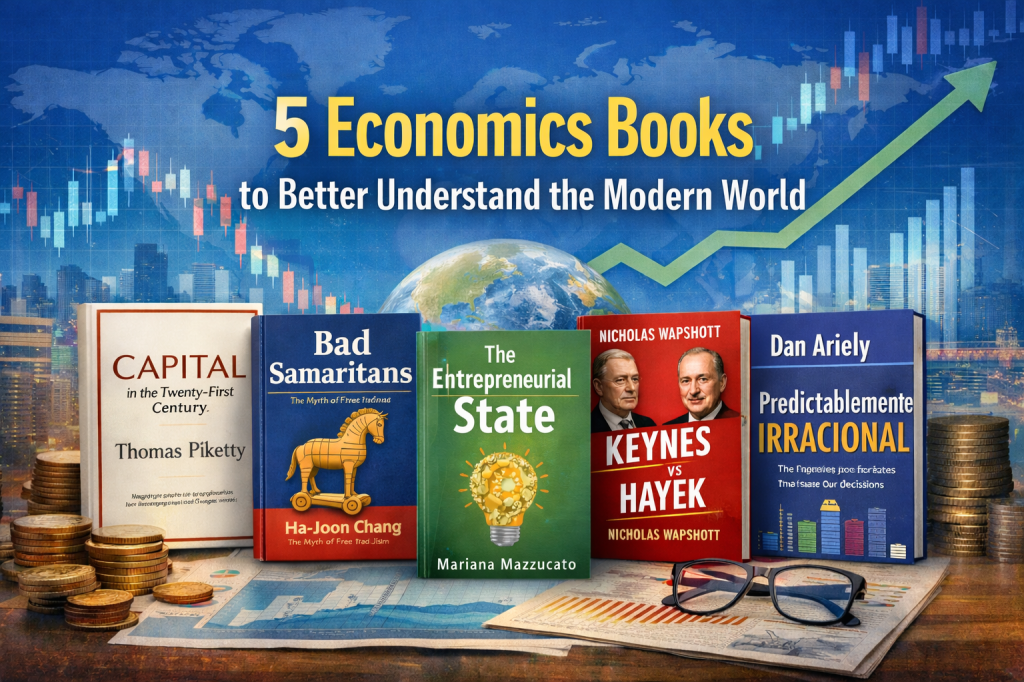
For those who want to better understand why economic growth doesn’t always translate into well-being, or how the systems that govern our economies actually work, these five books are an excellent gateway. Not only do they explain what is happening, but they also offer conceptual frameworks for thinking about the future with greater clarity and a critical spirit.
1. Capital in the Twenty-First Century — Thomas Piketty
Capital in the 21st Century is a demanding book, but accessible even to readers who do not have academic training in economics. Thomas Piketty demonstrates, with solid historical data, that the economic model of the richest countries has generated a growing concentration of wealth, weakening the middle classes and perpetuating poverty.
One of the author’s great contributions is his work with the World Inequality Database (WID.world), where he analyzes inequality by country and shows how it has increased steadily. Piketty proposes measures such as higher taxation of the richest 1% to redistribute resources and improve global living conditions.
This book is highly recommended if you are wondering why your country’s GDP is growing, but that growth is not reflected in your personal economy.
Keywords: economic inequality, concentration of wealth, GDP, Thomas Piketty.
2. Bad Samaritans — Ha-Joon Chang
Ha-Joon Chang, a South Korean economist and professor at the University of Cambridge, makes a direct critique of neoliberalism and the free market as universal recipes for development.
Chang demonstrates that no developed country grew under pure free market policies. Instead, they used industrial protectionism until their economies were strong enough to compete globally. Hence, many free trade agreements end up benefiting mainly industrialized countries, while weakening local industry in developing countries.
This book is key to understanding why, in many cases, the “free market” generates unequal competition and slows down sustainable economic growth.
Keywords: neoliberalism, free trade, economic development, Ha-Joon Chang.
3. The Entrepreneurial State — Mariana Mazzucato
Mariana Mazzucato dismantles one of the most widespread myths of modern capitalism: that innovation arises exclusively from the private sector. In The Entrepreneurial State, she shows how many of the great technological innovations were initially financed by the State.
Examples such as the Internet, the iPhone or the technologies behind companies such as Tesla show that the public sector took the greatest risks, financing research and development with no guarantee of immediate return. Once mature, these technologies were harnessed by the private sector.
This book helps to understand why the state can—and should—play an active role in economic development, especially in countries seeking to close technological gaps.
Keywords: innovation, entrepreneurial state, public investment, Mariana Mazzucato.
4. Keynes vs. Hayek — Nicholas Wapshott
This book presents in a clear and balanced way the debate between John Maynard Keynes and Friedrich Hayek, two of the most influential economic currents of the twentieth and twenty-first centuries.
On the one hand, Keynes defends state intervention to stimulate demand and correct market failures. On the other, Hayek (and later Milton Friedman) promotes laissez-faire and minimal state intervention. Wapshott exposes both positions rigorously, allowing the reader to draw his own conclusions.
It is essential reading to understand why the current economic model generates high levels of inequality and why economists such as Joseph Stiglitz or Paul Krugman openly criticize it.
Keywords: Keynes, Hayek, economic policies, state intervention.
5. Predictably irrational — Dan Ariely
This book dismantles one of the classic foundations of economics: the idea that human beings make rational decisions. Dan Ariely, from behavioral economics, demonstrates with real experiments that our decisions are full of cognitive biases and are highly influenceable.
Together with authors such as Daniel Kahneman (Nobel Prize in Economics) and Richard Thaler, Ariely shows that much of our economic behavior is predictable… precisely because it is irrational.
If you want to understand why you buy what you buy or how companies influence your decisions, this book is a must-have. On the blog I have a more extensive review that you can read here.
Keywords: behavioral economics, economic decisions, Dan Ariely.
Conclusion: economics books to think better about the present
These five books profoundly changed the way I understood the world. Not only do they explain how the economy works, but also why many of its failures are repeated and what alternatives exist to think about a fairer and more sustainable future.
If you’re interested in economics, public policy, or just a better understanding of the system we live in, these readings are a great place to start.
Did you like this post?
If you found it helpful:
Like it
Leave a Comment
Share it with other book and economy lovers
Follow me on X: @jamendezr89 or Instagram: @ontheside89
👉 Subscribe to the blog to receive new posts and essays delivered straight to your inbox.
 J. A. Méndez Authors Page and Blog