
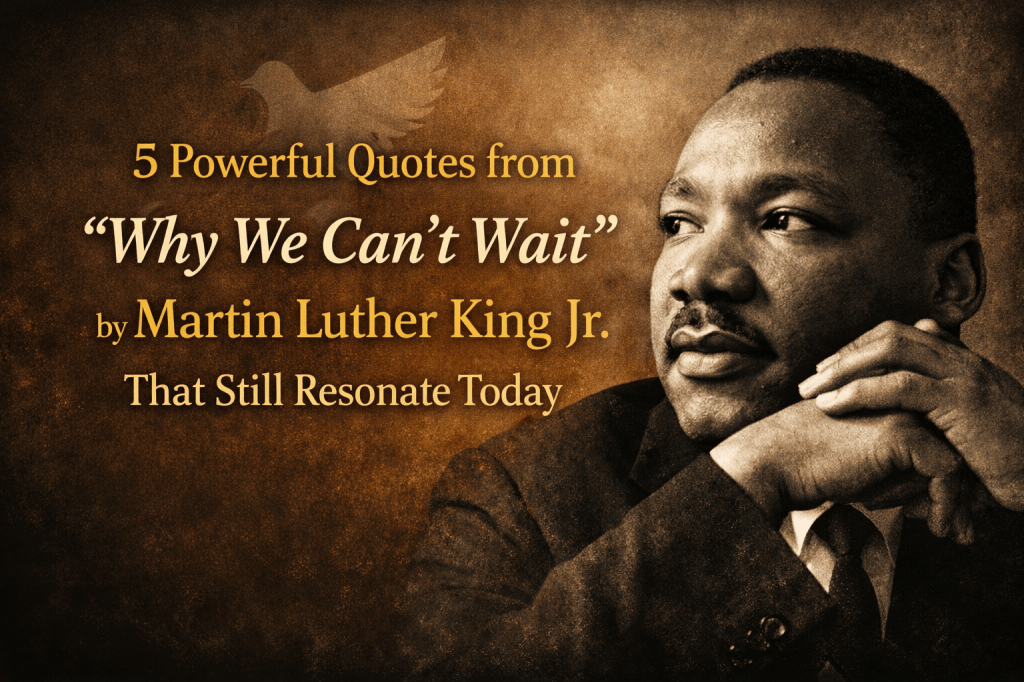
Every year, Martin Luther King Jr. Day is commemorated in the United States, but the relevance of Dr. King’s ideas extends far beyond American borders. Even for those of us who are not from the U.S., his influence remains profound and universal.
Reading Why We Can’t Wait confirms something unmistakable: Martin Luther King Jr. was not only a moral leader but also a deeply rigorous intellectual. In this book, he documents—clearly and unflinchingly—the struggle he and his followers endured during the Civil Rights Movement, a movement in which he became its most visible and courageous leader.
His leadership was rooted in sacrifice, discipline, and moral clarity—qualities that feel increasingly scarce today. More than ever, Dr. King’s message should resonate in our hearts and move us to action, whether we are facing collective injustices or personal struggles.
Below are five quotes from Why We Can’t Wait that feel especially relevant in our current times, along with reflections on why they still matter.
1. “Nonviolence is a powerful and just weapon… It is a sword that heals.”
“Nonviolence is a powerful and just weapon. It is a weapon unique in history, which cuts without wounding and ennobles the man who wields it. It is a sword that heals.”
This quote encapsulates the moral core of Dr. King’s philosophy. Nonviolence is not passivity—it is intentional, disciplined, and profoundly courageous.
The Civil Rights Movement began with small, peaceful actions carried out by ordinary people who refused to surrender their dignity. They marched peacefully while facing systemic violence. Many lost their lives, including Dr. King himself, but their cause prevailed.
In an era marked by polarization and performative outrage, this quote reminds us that true courage often lies in restraint, clarity, and persistence, not brute force.
2. “The posture of silent waiting was forced upon him psychologically…”
“The posture of silent waiting was forced upon him psychologically because he was shackled physically.”
Although written decades ago, this passage feels alarmingly contemporary. Today, psychological control often replaces physical chains—through distraction, fear, misinformation, and complacency.
These are weapons of mass distraction, designed to keep us passive and disengaged. Dr. King urges awareness as the first step toward freedom.
We break these shackles by:
- Reading deeply
- Writing to understand ourselves
- Asking difficult questions
- Actively seeking truth
The information is available—but awareness requires intention.
3. “The revolution… revealed him to himself.”
“The Revolution of the Negro not only attacked the external cause of his misery, but revealed him to himself.”
This quote closely echoes James Allen’s famous insight:
“Circumstances do not make the man; they reveal him to the world.”
Moments of crisis—personal or societal—demand growth. They force us to confront who we truly are and who we are willing to become.
When the stakes are high, we are called to rise to the level of the problem, even if our contribution feels small. Meaning is forged precisely when circumstances are most difficult.
4. “No revolution can take place without a methodology…”
“It is an axiom of social change that no revolution can take place without a methodology suited to the circumstances of the period.”
We are no longer in 1963. The world has changed—technologically, socially, and politically—but many underlying injustices persist in new forms.
This quote is a powerful reminder that strategy matters. Whether we are pursuing social change or personal transformation, success depends on understanding our context and adapting our methods accordingly.
Every era requires its own language, tools, and tactics.
5. Bonus Quote: “Injustice anywhere is a threat to justice everywhere.”
This quote may be Dr. King’s most widely cited—and for good reason.
Injustice is never isolated. What happens “far away” is often only separated by time, not relevance. Ignoring injustice elsewhere is an invitation for it to reach us eventually.
If we can act, we should.
If we cannot act directly, we should at least sound the alarm.
Silence has consequences.
Final Thoughts: Why We Still Can’t Wait
Why We Can’t Wait is a book filled with wisdom, moral clarity, and unwavering resolve. It teaches leadership not as dominance, but as responsibility. It reminds us that waiting for the “right time” is often a luxury history does not allow.
I strongly recommend reading this book—not only as a historical document, but as a guide for navigating our present moment.
Did you like this post?
If you found it helpful:
- Like it
- Leave a comment
- Share it with other book lovers
Follow me on:
- X (Twitter): @jamendezr89
- Instagram: @ontheside89
👉 Subscribe to the blog to receive new posts and essays delivered straight to your inbox.
 J. A. Méndez Authors Page and Blog