
Obsession, Longevity, and the Modern Quest for Immortality
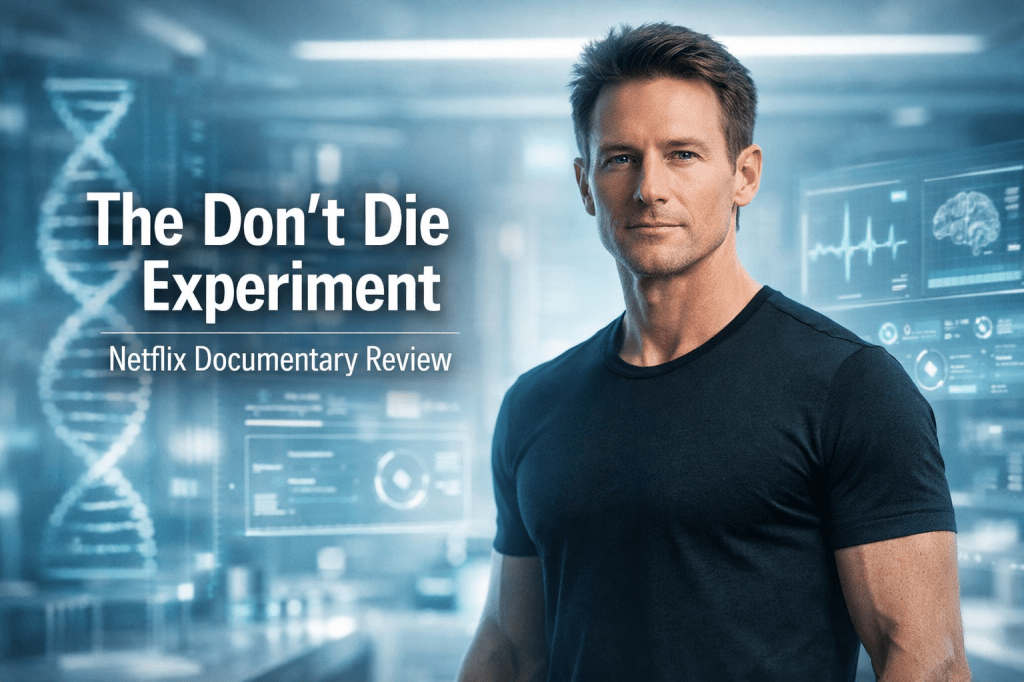
Don’t Die is a new Netflix documentary that explores one of the most extreme longevity experiments of our time, led by millionaire entrepreneur Bryan Johnson. His mission is radically simple and profoundly unsettling: to not die.
In the documentary, Johnson presents himself as a living laboratory—an individual who has transformed his entire existence into a controlled scientific experiment aimed at reversing aging and extending human lifespan. Through a highly regimented lifestyle of medical protocols, supplements, treatments, and biometric tracking, he claims to have reduced his biological age significantly. Physically, the results are striking—he now looks remarkably similar to his 20-year-old son.
But Don’t Die is not merely a story about biohacking or anti-aging. It is a psychological, philosophical, and cultural exploration of what happens when wealth, technology, fear of death, and scientific ambition converge.
From Entrepreneurial Success to Existential Crisis
The documentary retraces Johnson’s journey from building massive wealth through successful business ventures to confronting a brutal realization: the lifestyle that made him rich was slowly killing him. Stress, exhaustion, and unhealthy habits had taken a toll on his body and mind.
Rather than making incremental changes, Johnson chose a radical path—total transformation.
He rebuilt his life around a singular objective: maximal longevity optimization.
This includes:
- A strict vegan diet
- Intense daily physical training
- Extreme sleep discipline
- Advanced skin and hair treatments
- Over 130 daily supplements and medications
- Constant biometric monitoring
- A dedicated medical team
He documents everything publicly, turning his personal health into a data-driven project and an open-source experiment for humanity.
A Human Guinea Pig
Johnson openly refers to himself as a “human guinea pig.”
Despite warnings from his own medical team about the long-term risks of constant experimentation, he continues pushing boundaries.
Some of the most controversial practices shown in the documentary include:
- Experimental gene therapy
- Plasma transfusions using his son’s blood (based on animal studies)
- Traveling internationally for unapproved medical treatments
- Radical longevity protocols with limited long-term human data
Recently, the documentary reveals his visit to an island in Honduras for experimental genetic interventions—highlighting how far he is willing to go in pursuit of biological immortality.
Cult Following and the Birth of a Movement
What makes Don’t Die particularly compelling is not only Johnson himself, but the ecosystem forming around him.
He has created a growing community—a digital tribe of followers who adopt the “Don’t Die lifestyle” as a philosophy of extreme health optimization. It resembles a modern movement that blends:
- Biohacking culture
- Transhumanist ideology
- Silicon Valley techno-optimism
- Wellness extremism
- Data-driven self-experimentation
Health, in this context, becomes not just well-being—but identity.
Personal Life and Emotional Depth
Beyond the science and spectacle, the documentary also explores Johnson’s personal relationships: his father, ex-wife, and children.
One of the most emotionally powerful arcs is his relationship with his father—who transitions from skeptic to supporter, eventually becoming one of his closest companions in these experiments.
This human element grounds the documentary and prevents it from becoming purely technological spectacle.
Philosophical Undertones
At its core, Don’t Die is not just about longevity—it is about meaning.
Johnson claims he is doing this “for humanity,” and there is sincerity in that belief. Yet the film subtly raises deeper questions:
- Is extreme longevity a form of transcendence or fear?
- Where is the line between discipline and obsession?
- Can the pursuit of health become a form of self-destruction?
- Does eliminating death eliminate meaning?
In this sense, the documentary echoes existentialist philosophy. One could easily imagine Albert Camus interpreting Johnson’s project as a modern revolt against the absurd—an attempt to impose meaning on the inevitability of death through radical action.
Final Verdict
⭐ Rating: 4 out of 5 stars
The dream of eternal life has haunted human imagination for millennia—from the Fountain of Youth to alchemy to modern transhumanism. Don’t Die offers a fresh, modern, data-driven perspective on that ancient fantasy.
This documentary is:
- Thought-provoking
- Visually compelling
- Emotionally complex
- Ethically challenging
- Philosophically rich
It does not glorify Johnson uncritically, nor does it demonize him. Instead, it presents a nuanced portrait of a man turning his body into a frontier of scientific exploration.
If you are interested in:
- Biohacking
- Longevity science
- Transhumanism
- Health optimization
- Existential philosophy
- Extreme wellness culture
This documentary is absolutely worth watching.
Did you enjoy this review?
If you found it valuable:
- Like the post
- Leave a comment
- Share it with other documentary and philosophy lovers
Follow me on:
- X (Twitter): @jamendezr89
- Instagram: @ontheside89
👉 Subscribe to the blog to receive new essays, reviews, and reflections delivered directly to your inbox.
 J. A. Méndez Authors Page and Blog