
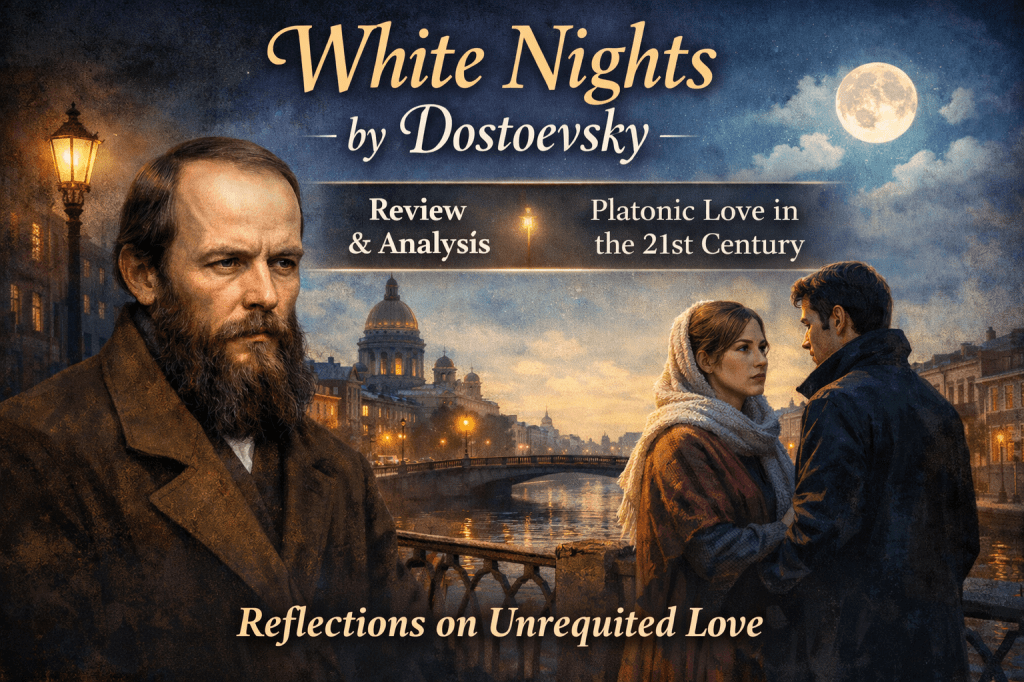
Dostoyevsky’s White Nights: Review and Reflection on Platonic Love
White Nights is the first novel I read by Fyodor Dostoyevsky. Before anyone shouts “sacrilege,” I must say in my defense that for many years I was not a regular reader of fiction. Interestingly, it was after writing my first novel that I started to get closer to these types of books. Over time I have understood that fiction contains profound morals that, in many cases, become almost exclusive to each reader.
Published in 1848, White Nights is a short novel that narrates four decisive nights in the life of its protagonist, a young dreamer who is also the narrator of the story. His name is never mentioned, and I don’t think it’s a coincidence: anyone who has loved without being corresponded can see themselves reflected in him.
Summary of White Nights
During these four nights, the narrator meets Nastenka, the woman of his dreams. She, however, finds herself trapped in a heartbreak and emotionally committed to another man. The protagonist, unable to clearly express his true intentions, falls into a situation that today we would call a “friend zone”, which leads him to a silent and contained frustration (an experience with which many readers can identify).
Despite his efforts to change her mind, Nastenka remains faithful to the hope that her old love will return. And when he finally does, she doesn’t hesitate to leave with him, leaving the narrator in a mixture of pain, resignation and acceptance.
White Nights is, in essence, the perfect portrait of platonic love: a love that is built, grows and idealized mainly in the imagination of those who feel it.
What does White Nights teach us?
One of the main lessons that this work of Dostoyevsky taught me is the importance of emotional clarity, especially when it comes to love. Being ambiguous at the beginning of a relationship is often a recipe for failure. Honestly expressing one’s intentions may involve the risk of rejection, but it also avoids prolonged and unnecessary suffering.
If the feeling is reciprocated, the relationship advances; If it is not, the pain comes sooner, but so does the opportunity to heal faster. The other option is to insist, always with dignity, without falling into dependence or losing self-respect. Although there is a risk of being used emotionally, it is a risk that, at times, is part of human learning.
The relevance of White Nights in the 21st century
Despite being written more than 170 years ago, White Nights is still deeply relevant. Unrequited infatuation, idealized love, and emotional vulnerability are still universal experiences.
The most interesting thing is how the narrator manages his frustration: he does not resort to violence or resentment but accepts his pain with a silent maturity. In a modern world that, despite its advances, continues to drag sexist behaviour and a worrying glorification of brute force, this message is more relevant than ever.
Dostoevsky reminds us of the importance of self-control, empathy, diplomacy and humility. In a society where we often wear masks, falling in love implies showing vulnerability. And accepting rejection, although painful, is one of the experiences that makes us grow the most and prepares us to find better alternatives.
Final Verdict
⭐ Rating: 4 out of 5 stars
White Nights is a short novel that more than fulfills its objective: to entertain and make people think. It has philosophical depth, subtly humorous moments and prose accessible even to those who are new to Dostoyevsky’s work.
I recommend it for a rainy afternoon, a moment of conscious solitude or as an excellent excuse to put your cell phone aside for a few hours. In my case, it has been an ideal read as I continue to explore the author with The Idiot.
Did you like this review?
If you found this post helpful or interesting:
- Like.
- Leave a comment with your opinion.
- Share it with other literature lovers.
Follow me on X: @jamendezr89Sígueme on Instagram: @ontheside89
👉 Subscribe to the blog to receive new reviews, essays, and reflections delivered straight to your inbox.
 J. A. Méndez Authors Page and Blog