
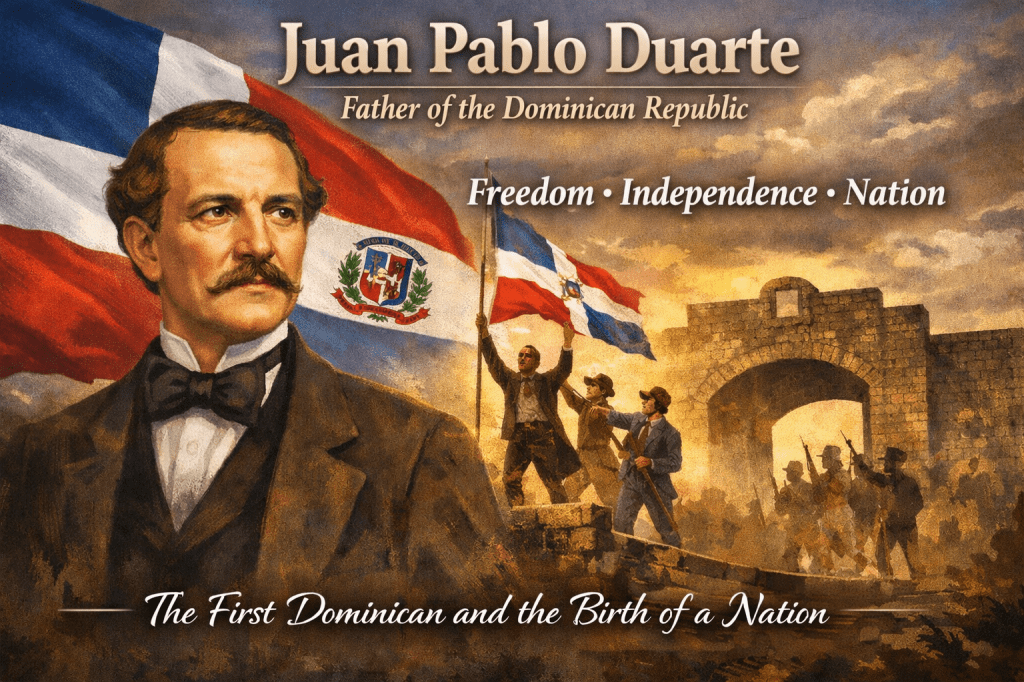
Yesterday we celebrated a new anniversary of the birth of Juan Pablo Duarte, the Father of the Dominican Homeland and one of the most transcendental figures in the history of our nation. Duarte was not only an independence hero; He was a political visionary, a thinker ahead of his time and the moral architect of the Dominican project.
Since I was a child I developed a special interest in his figure, instilled by my parents and reinforced by my late aunt, a sociologist passionate about national history. Today I want to pay tribute to him from this space, remembering not only his greatness, but also the depth of his legacy.
Duarte’s beginnings: growing in times of crisis
Juan Pablo Duarte was born during the period known as Silly Spain, a period of colonial abandonment in which the island suffered a deep economic, political and social crisis. Spain had diverted its interest to the riches of the American continent, leaving Santo Domingo practically without resources or support.
When Duarte was just nine years old, the eastern part of the island was occupied by Haiti, a newly independent nation and one of France’s most prosperous former colonies. The invasion was facilitated by local economic weakness and by Haiti’s strategy of unifying the island to pay off the huge debt imposed by France after Haitian independence. This occupation lasted for 22 years, profoundly marking Duarte’s identity and political consciousness.
The awakening of his independence ideas
Duarte’s ideas of independence were strengthened during his trips to Europe and the United States, where he came into contact with liberal, republican, and revolutionary currents. However, his thinking was also influenced by his early training.
He was a disciple of Juan Vicente Moscoso, who together with José Núñez de Cáceres led the so-called Ephemeral Independence of 1821. These experiences shaped Duarte’s vision of sovereignty, self-determination, and the need for a free and dignified Dominican state (according to Orlando Inoa’s Biography of Duarte).
The “Christ of Freedom”: myth and humanity
Former President Joaquín Balaguer, in his eagerness to honor Duarte, contributed to idealizing him until he became an almost divine figure. While well-intentioned, this approach can distort his legacy, making him seem unattainable to the ordinary citizen.
I prefer biographies like Orlando Inoa‘s, which humanize Duarte: they show him as an extraordinary man, but also with defects, doubts and internal struggles. Both visions are valuable. Balaguer, for example, dismantles unjust myths – such as the false accusation that Duarte avoided fighting – and clarifies that he was betrayed by Tomás Bobadilla and Pedro Santana, which led to his exile.
The Sower of Ideals
Duarte’s impact transcended his generation. His ideals inspired the heroes of the Restoration, who fought against annexation to Spain and definitively consolidated Dominican sovereignty.
The Dominican Republic is one of the countries that has fought the most to preserve its independence, a historical effort comparable even to nations such as Vietnam. Our national identity is marked by resistance, resilience and the constant defense of sovereignty.
Propaganda, identity and national pride
The countries of the so-called “third world” are often the constant target of demoralizing propaganda, designed to erode faith in the national project. Falling into that trap is a mistake.
We must actively understand our history, recognize both our successes and our mistakes and study the path traveled by today’s developed nations. Their progress was not linear or perfect. We can also achieve higher levels of development, not only economically, but also in welfare, social justice and equality of opportunities.
To honor Duarte is to live his ideals
Let us proudly celebrate Juan Pablo Duarte, not only with words, but by imitating his ethics, his commitment to the nation and his love for freedom. Defending his legacy implies working every day for a more just, sovereign and dignified Dominican Republic.
Did you like this post?
If you found this article helpful or inspiring:
✅ Like it
💬 Leave a Comment
🔁 Share with other history lovers
📌 Follow me on X: @jamendezr89
📸 Instagram: @ontheside89
📬 Subscribe to the blog to receive new essays directly in your inbox.
 J. A. Méndez Authors Page and Blog